

How to Prevent Wrinkles in Linen Clothing
Table of Contents
- Why Linen Wrinkles and What You Can Control
- How to Wash Linen Clothes to Reduce Wrinkles
- How to Dry Linen Clothes Without Excess Creasing
- How to Get Wrinkles Out of Linen Without Ironing
- How to Pack Linen Clothes Without Wrinkles
- Fabric Blends, Construction, and Care Labels Matter
- Preventing Wrinkles During Wear and Storage
- Sustainable Care: Low-Impact Wrinkle Prevention
- Frequently Asked Questions
Last Updated: October 12, 2026
Why Linen Wrinkles and What You Can Control
Linen wrinkles naturally: its looser weave lets fibers move freely, so creases form when moisture and movement interact. How to prevent wrinkles in linen clothing starts with what you control: washing, drying, and storage.
Many creases come from washing and drying itself. Handle linen right from the hamper and you'll cut wrinkles dramatically before you touch an iron.
Linen breathes better than cotton, keeps you cooler, and softens with every wash, but that same structure makes it prone to creasing. Work with the fabric, not against it.
How to Wash Linen Clothes to Reduce Wrinkles
Washing sets up the entire drying process, and harsh washing creates creases that are harder to remove later.
Choose a Delicate Cycle and Cold Water
Use a delicate cycle every time, a standard cycle agitates fabric too much, forcing fibers to bend and crease. Cold water matters too: hot water weakens fibers and makes permanent creasing more likely.
Fill the machine only three-quarters full; overcrowding forces garments to fold on themselves. Cold water plus a delicate cycle keeps fibers relaxed, one of the most effective steps in how to prevent wrinkles in linen clothing.
Use Less Detergent and Rinse Thoroughly
Excess detergent gets trapped in the weave and stiffens the fabric, making wrinkles more visible and harder to remove.
Use half the usual amount, a quarter-cup is enough for a full load, and gentle plant-based formulas work as well as heavy-duty ones. Run an extra rinse cycle: residue stiffens fabric and emphasizes wrinkles, while a thorough rinse leaves linen soft enough for gravity to smooth minor creases as it dries.
How to Dry Linen Clothes Without Excess Creasing
Drying is where most wrinkle prevention happens. What you do in the few minutes after the washer determines whether you'll need heavy ironing later.
Skip or Reduce the Spin Cycle
The spin cycle is your enemy for how to prevent wrinkles in linen clothing. High-speed spinning twists and compresses fabric into deep creases that are nearly impossible to remove without steam or an iron.
Use a low-spin option if you have one; if not, stop the cycle manually before it spins or let it run just 20-30 seconds. Damp linen is easier to smooth than dry.
Remove and Smooth Garments While Damp
Pull garments out the moment the wash cycle ends, wet linen left in a warm washer develops stubborn creases within minutes.
Shake each piece, then smooth it flat with both hands from the center outward, 30-60 seconds per piece, focusing on seams, collars, and cuffs where wrinkles concentrate.
Smoothing damp fabric is far easier than ironing it dry: moisture makes fibers pliable and gravity flattens them as they dry.
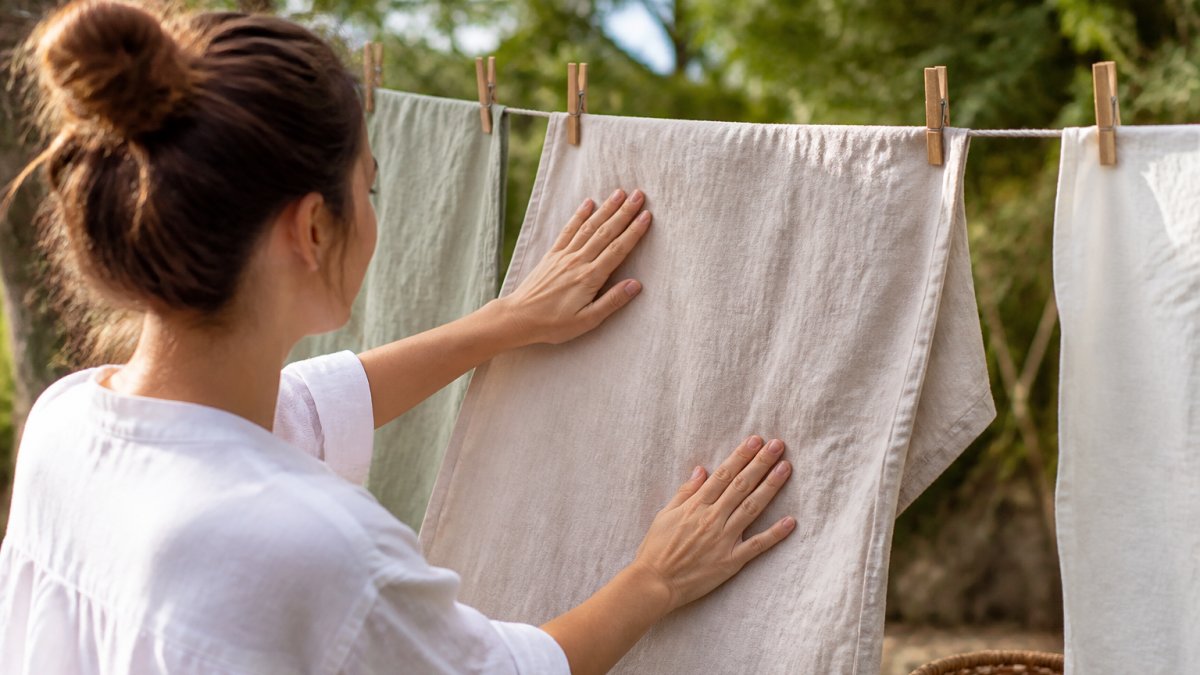
Air-Dry by Hanging or Laying Flat
Never use a dryer for linen, tumble drying creates wrinkles and damages fibers over time. Hang garments on a clothesline, drying rack, or sturdy hanger instead.
For hanging:
- Use padded hangers to prevent creases at the shoulders
- Hang items in a well-ventilated space away from direct sunlight (sun can yellow linen over time)
- Leave enough space between garments so air can circulate freely
For laying flat:
- Spread garments on a clean, dry surface like a drying rack or mesh screen
- Smooth the fabric flat and let gravity do the work
- This method works best for delicate pieces or items with embroidery
Air-drying takes 4-8 hours depending on humidity and airflow; patience here saves ironing time later.
How to Get Wrinkles Out of Linen Without Ironing
Sometimes wrinkles still happen. To refresh linen without a full ironing session, match the method to the depth of the crease and the garment's construction.
Steam for a Quick Refresh
A handheld steamer removes wrinkles without an iron's flat-pressing heat. Steam relaxes fibers and lets gravity smooth them, the fastest no-iron option for a clean garment that just looks tired.
How to steam linen properly:
- Hang the garment freely on a sturdy hanger; a padded hanger prevents shoulder dimples.
- Use distilled water if your tap water is hard, minerals can leave white spots on linen.
- Hold the steamer 6-8 inches from the fabric: closer risks spitting water droplets, farther lets the steam cool.
Steaming works best on minor, body, and storage wrinkles. It struggles with sharp fold lines pressed in for months and can't fix creases heat-set by a hot dryer.
Iron on Low Heat While Damp
If you must iron, do it while the linen is still slightly damp.
Set your iron to low or medium-low heat, roughly the "silk" or "wool" setting.
Use a pressing cloth, a clean cotton pillowcase or white cotton fabric, to protect the linen from direct heat and prevent a sheen.
Press gently and let the iron's weight do the work, working in sections: collar, shoulders, sleeves, body, hem.
Troubleshooting Creases That Won't Budge
Some wrinkles resist both steaming and ironing. The most common stubborn cases:
Deep set-in wrinkles from storage. Hang the garment in a steamy bathroom for 20-30 minutes, then gently tug along the crease line while it's warm and damp; humidity plus tension usually releases it.
Over-dried linen. If a garment went through a full dryer cycle or sat in a hot car, the fibers have locked into their wrinkled shape.
Creases that return after ironing. If a crease comes back within an hour, the fabric wasn't fully dry or you ironed over an already-set fold.
Shine marks from a too-hot iron. These are permanent fiber damage, not a wrinkle.
When to Skip the Iron Entirely
Some linen doesn't need ironing at all. Stonewashed, heavy-weight, and textured-weave blends often look better with their natural creases left alone, the relaxed, lived-in look is part of the appeal. Save the iron for structured pieces like collared shirts, trousers, and blazers where a sharp line matters.
How to Pack Linen Clothes Without Wrinkles
Travel with linen requires a different packing strategy. Linen wrinkles easily when folded tightly in a suitcase.
Roll instead of fold: rolling compresses fabric less and reduces the sharp creases that form along fold lines.
On longer trips, hand-wash linen as you go and air-dry it properly at your accommodations.
Fabric Blends, Construction, and Care Labels Matter
Not all linen is equal. Weave, blend, and construction affect how much a piece wrinkles, and the care label tells you the manufacturer's limits. Reading both before washing is the difference between a garment that stays smooth and one that shrinks, fades, or sets in creases you can't remove.
How Weave and Weight Change Wrinkle Behavior
Linen's wrinkle tendency comes from long, smooth cellulose fibers with low natural elasticity: when the fabric bends, the fibers don't spring back like wool or polyester.
- Tight, dense weaves (like a plain-weave linen shirt) hold their shape better and crease less visibly than loose, open weaves. The fibers have less room to shift, so creases form more slowly.
- Loose, open weaves (like a gauze or slub linen) wrinkle more dramatically but also release wrinkles more easily with steam, because air and moisture move through the fabric quickly.
- Heavier weights (think 200 GSM and up, common in trousers and jackets) drape with more gravity, which pulls creases out naturally. They also take longer to dry and hold more moisture, so they benefit most from damp ironing.
A useful rule: the heavier and denser the linen, the more you can rely on gravity and hanging; the lighter and looser it is, the more you need steam or a damp iron.
What Blends Do to Wrinkle Resistance
100% linen wrinkles. Blends change the equation by adding fibers with different elastic properties.
- Linen-cotton is the most common blend. Cotton adds a bit of body and reduces creasing slightly, but the linen still dominates the look and feel. Expect maybe 20-30% less wrinkling than pure linen, not a dramatic difference.
- Linen-viscose (rayon) drapes beautifully and wrinkles less than pure linen, but viscose weakens when wet. Wash these blends on the gentlest cycle and never wring them.
- Linen-synthetic blends (polyester, elastane, or nylon) wrinkle the least. The synthetic fiber acts like a spring, helping the fabric recover its shape. A linen-poly blend might wrinkle half as much as pure linen. The trade-off is breathability: synthetics trap heat, so you lose some of linen's cooling benefit.
If wrinkle resistance is your top priority, choose a linen-synthetic blend. If breathability and natural texture matter more, stay with 100% linen and lean on the care techniques in this guide.
Reading the Care Label Before You Wash
Care labels use standardized symbols, and they matter more for linen because it's less forgiving of mistakes. What to look for:
- Wash tub with a number tells you the maximum temperature in Celsius. For linen, stay at 30°C (about 85°F) or below unless the label explicitly allows warmer. Hot water shrinks linen and sets wrinkles.
- Wash tub with a hand means hand-wash only. This is common on lightweight or embellished linen. Don't put it in the machine, even on delicate.
- Triangle with an X means do not bleach. Chlorine bleach yellows linen and weakens the fibers. If you need to brighten white linen, use an oxygen-based bleach (like OxiClean) instead, and only if the label allows it.
Dyes, Trims, and Stains: Special Precautions
Linen takes dye differently than cotton, and some dyes are less colorfast. A few practical rules:
- Wash new dark or brightly dyed linen separately for the first 2-3 washes. Some dye bleed is normal, especially with indigo, deep reds, and saturated blues. Cold water reduces bleed.
- Turn garments inside out before washing to protect the dyed surface from friction and fading.
- Remove trims before washing if possible. Detachable belts, brooches, and decorative pins can snag the weave or rust in the wash.
If the care label says dry clean only, don't hand-wash it just to avoid wrinkles, the risk of shrinkage, color loss, or lining damage outweighs skipping a trip to the cleaner.
Construction Details That Affect Creasing
How a garment is sewn matters as much as the fabric. A few construction features change how linen wrinkles and how easily you can smooth it:
- French seams enclose raw edges and create a slightly stiffer seam line. They can show creases more than a plain seam, but they hold their shape better over time.
- Lined garments (blazers, skirts) wrinkle less on the outside because the lining adds a layer of structure, but the lining itself can wrinkle and is harder to press.
- Bias-cut pieces drape more fluidly and wrinkle less visibly than straight-cut pieces, because the fabric moves with the body rather than against it.
At Tahorah Wellness LLC, our Linen Jumper is made from Oeko-Tex 100 certified linen with a relaxed fit that accommodates the fabric's wrinkle tendency, designed for durability and comfort rather than perfection.

Our Hadassah Wrap Dress is made from 100% stonewashed Cairo linen. The stonewashing process softens the fabric and actually reduces the appearance of wrinkles by creating a naturally textured surface.

Preventing Wrinkles During Wear and Storage
How you wear and store linen between washes also affects wrinkles.
Avoid tight belts and constrictive waistbands that create permanent crease lines.
Store linen on hangers rather than folded in drawers so the fabric relaxes under its own weight.
When you do wear linen, expect some wrinkling. It's part of the fabric's character.
Sustainable Care: Low-Impact Wrinkle Prevention
Smart washing and drying also reduces your environmental impact.
Air-drying uses zero electricity, hand-smoothing damp fabric uses no energy at all, and steaming uses less than ironing because it's shorter and more targeted.
Linen is one of the most sustainable natural fibers, grown with minimal water and pesticide use.
Our Pillowcase Set is made from 100% linen and designed for longevity.

How to prevent wrinkles in linen clothing comes down to one principle: work with the fabric's nature, not against it.
Frequently Asked Questions
Why does linen wrinkle so easily, and can you prevent it completely?
Linen wrinkles naturally because of its structure: the cellulose fibers lack the elasticity to bounce back after being compressed or wet. You cannot eliminate wrinkles entirely, but you can minimize them significantly through gentle washing, prompt removal from the washer, smoothing while damp, and air-drying. The key is working with linen's nature rather than against it. Accepting some creases as part of linen's character is part of choosing this natural fiber.
How should you wash linen clothing to reduce wrinkles?
Wash linen on a delicate cycle with cold water and less detergent than you'd use for other fabrics. Rinse thoroughly to remove soap residue, which can stiffen fabric and worsen creasing. Avoid heavy agitation and reduce or skip the spin cycle if your machine allows it. Remove garments immediately after washing while they're still damp, shake them gently, and smooth them by hand before hanging to air-dry. This entire process minimizes the formation of set-in creases.
Is it better to air-dry or machine-dry linen?
Air-drying is far better for preventing wrinkles. Hang linen garments on a clothesline or lay them flat on a clean surface while still damp. Machine drying, especially on high heat, locks in wrinkles and can damage natural fibers. If you must use a dryer, use the lowest heat setting and remove garments while slightly damp, then hang them to finish drying. Air-drying also reduces energy consumption, making it the most sustainable choice for your linen clothing.
How do you get wrinkles out of linen without ironing?
A garment steamer is the easiest no-iron option: hold the steamer a few inches from the fabric and let steam relax the fibers without direct contact. Another option is damp ironing on a low steam setting while the fabric is still moist from washing or dampening. If you do iron, use a low temperature and iron while damp for best results with minimal heat damage.
Best Natural Remedies for Immune Health: A 2026 Guide
Tallow Balm vs Commercial Face Cream: Which Suits Your Skin?
Related Posts

How to Soothe Sensitive Skin Naturally

Tallow Balm vs Commercial Face Cream: Which Suits Your Skin?

Best Natural Remedies for Immune Health: A 2026 Guide

Tallow Skincare for Dry Skin: A Practical 2026 Guide
